Research & scienceRobot control
AgentRoboCritic framework scores each robot control action against stated intent
The arXiv paper pairs each control action with a stated local intent, then has a critic score the outcome and failure mode. The release includes a 12,844-action dataset and an open critic.
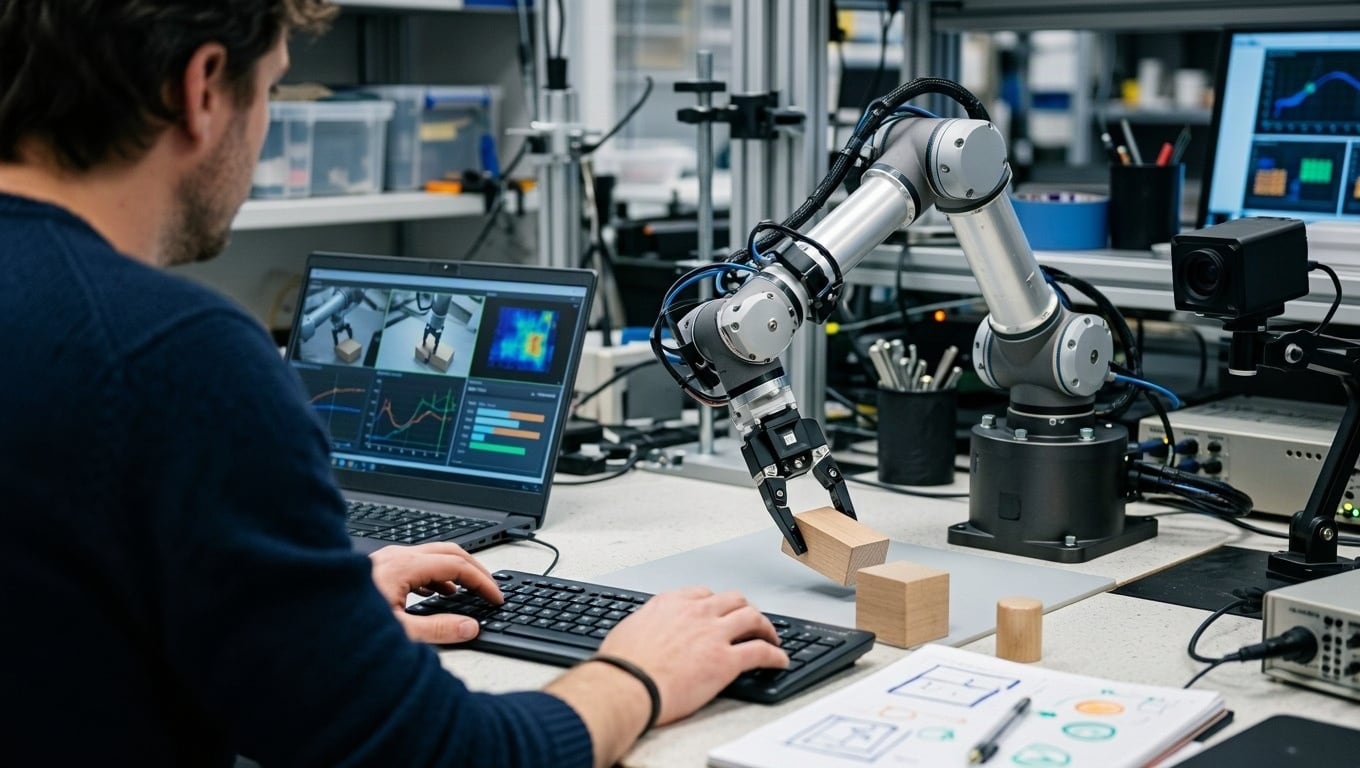 AI illustration
Why it matters
Episode-level success rates hide where a robot controller actually breaks down. Action-level critique could make failure analysis cheaper and more repeatable, focusing attention on physical execution problems such as grasping and alignment.
On 2026-11-20, the paper “AgentRoboCritic: Understanding the Capability of Frontier Agents on Direct Robot Control” was posted to arXiv as 2611.26613v1. According to the authors, existing benchmarks report only episode-level success rates, which show neither how agents succeed nor where they fail. The work presents a systematic action-level analysis of frontier agents on direct robot control across 12 manipulation benchmarks.
AgentRoboCritic is an intent-grounded critique framework. The policy agent states a local intent alongside each action, and a critic evaluates the action's outcome and failure mode against that intent.
AnalysisThe paper says frontier multimodal language agents such as GPT-6 Astra have demonstrated strong capabilities in controlling robots directly through low-level numerical actions, without high-level primitives. In plain terms, the models issue commands close to the machine rather than choosing from a short menu of pre-built skills.
AnalysisAt the action level, the authors see promising capabilities: closed-loop recovery, reliable semantic grounding, and strong zero-shot manipulation. Closed-loop recovery suggests the agent can notice a mistake and adjust its next action; semantic grounding suggests its language connects to objects in the scene; zero-shot manipulation suggests it can handle tasks without task-specific training. The same analysis identifies current limits, including task-relevant physical execution bottlenecks such as grasping and alignment, and uneven recovery across failure modes. Even when the agent seems to understand what to do, it can struggle to grip an object or line it up correctly, and some failure modes are corrected more consistently than others.
To check the critic, the authors validated it on a 400-action human-annotated benchmark. They also released a dataset of 12,844 annotated actions, plus a fine-tuned open-source critic named Muse-Glimmer-30B. On that 400-action benchmark, the fine-tuned critic's failure-mode accuracy rises from 32.58% to 74.24%.
AnalysisThe authors frame the critic as enabling low-cost action-level analysis. If reliable at scale, that would let researchers inspect far more individual control actions than manual annotation makes practical, and compare failure modes across models and manipulation tasks.
Timeline
AgentRoboCritic paper posted to arXiv as 2611.26613v1
Sources
Written with AI assistance from the sources listed above. Its facts were checked against those sources and the article was proofread before publication. How we work