New productsAssistive tech
7Sense's SuperBrain 1 lets blind users feel their surroundings on their forehead
The Tallinn startup's €9,000 headset turns 3D and thermal camera data into a pattern of touch. The science behind it is sound — independent evidence of how well it works is still thin.

Why it matters
Many electronic navigation aids for blind people speak or beep, and sound competes with traffic and conversation. A head-worn touch display is a different approach: if it holds up outside demonstrations, it adds a channel that leaves the ears free.
Many digital aids for blind people speak or beep. SuperBrain 1, from the Estonian startup 7Sense, works through touch instead. The head-worn device scans what is around the wearer with cameras and sensors and turns it into a moving pattern of touch on the forehead, so objects, movement and distance are felt rather than seen or heard.
How it works
7Sense says the headset combines 3D stereo vision, time-of-flight sensors and, in SuperBrain 1, a thermal camera that reads the temperature of objects. The data becomes what the company calls a "haptic space", which is passed to its Haptic Mat — an array of contact points that rests against the forehead. According to the company's FAQ, the device does not interact with the eyes at all, and you do not have to be blind to use it.
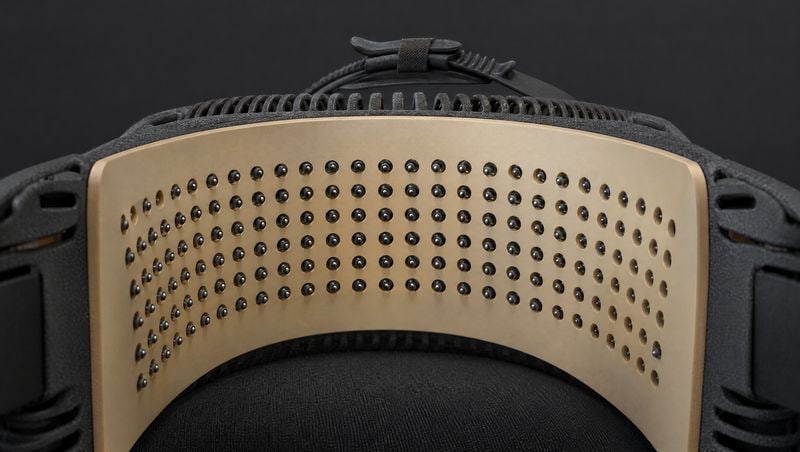
The Haptic Mat: the array of contact points that rests on the forehead.
A European Innovation Council showcase of companies it funds describes the material as a "display for the skin" that gives a continuous sense of touch, unlike vibration-based haptic interfaces. A Norwegian blind user quoted by the site Innovations of the World described the effect like this:
“If I put the ball on the table and look at it, it feels like I have a physical ball projected onto my forehead.”
Blind user from Norway, quoted by Innovations of the World
Two models, two prices
The two models, as listed by 7Sense
- SuperBrain 1 — €9,000 plus VAT. 185° horizontal and 120° vertical field of view, thermal camera, and an SDK so other developers can build haptic apps ("hApps").
- SuperBrain Lite — €5,499 plus VAT. 87° horizontal and 120° vertical field of view, no thermal camera, no third-party development.
- Both — up to three hours per charge, can run from a power bank, Bluetooth and Wi-Fi, downloadable hApps.
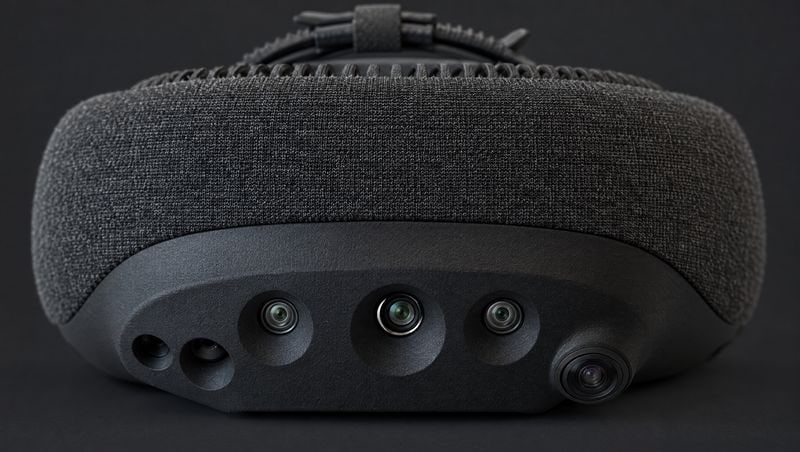
SuperBrain 1 seen from the front. The cameras and sensors sit in the band above the wearer's eyes.
Innovation Library reported in 2025 that SuperBrain 1 was on sale in Estonia, the UK, Germany, the Netherlands, Norway and Spain, with a two-year warranty and a 30-day buyback guarantee. 7Sense's own site does not list sales countries; it offers demonstrations through partner organizations and a sales contact.
Who is behind it
Seventh Sense OÜ is based in Tallinn, and its chief executive is Johannes Väänänen. In 2024, Trade with Estonia, the Estonian government's export portal, reported that the company had ten full-time employees and named Madis Päev as its sales and marketing director. Its partners include the Estonian Blind Union, East Tallinn Central Hospital, Luxembourg's Fondation Lëtzebuerger Blannevereenegung and Norway's Eikholt Foundation.
The company is co-funded by the EU's EIC Accelerator program; 7Sense does not state the size of that grant. A separate Estonian grant of €34,562.50 paid for concept work on a second-generation device. Trade with Estonia also reported interest from Deutsche Telekom, to explore telehaptics beyond the current product, and from Nvidia, which gives the company early access to new technology. The article described no contracts or investments.
What is not known yet
AnalysisSensory substitution — feeling what the eyes cannot see — is established science; BrainPort, which works through the tongue, is the better-known example. What SuperBrain 1 still lacks is independent evidence. 7Sense publishes no weight, no sensing range, no number of contact points and no trial results, and the gadget blog Mike Shouts notes that independent studies and hands-on reports are few.
AnalysisHow long it takes to learn to read the signals is also open. Innovation Library writes that the interface does not require significant training; Mike Shouts doubts that it will be effortless. Until there is published data, the most reliable test is the one 7Sense itself offers: a demonstration with one of its partners.
Sources
- 7SenseSuperBrain 1 — Wearable Haptic DeviceOriginal source
- 7SenseSuperBrain LiteOriginal source
- 7SenseAbout 7SenseOriginal source
- 7SenseFrequently Asked QuestionsOriginal source
- European Innovation CouncilEIC-backed start-ups & scale-ups: showcase of EIC innovators
- Trade with Estonia7Sense captures Deutsche Telekom and Nvidia's attention with groundbreaking technology
- Innovation LibraryHow SuperBrain 1 translates sight into sensation
- Innovations of the World7Sense — telehaptic technology: redefining sight through a remote sense of touch
- Mike Shouts7Sense SuperBrain 1 uses AI and haptic feedback to help blind and visually impaired users
Written with AI assistance from the sources listed above. Its facts were checked against those sources and the article was proofread before publication. How we work